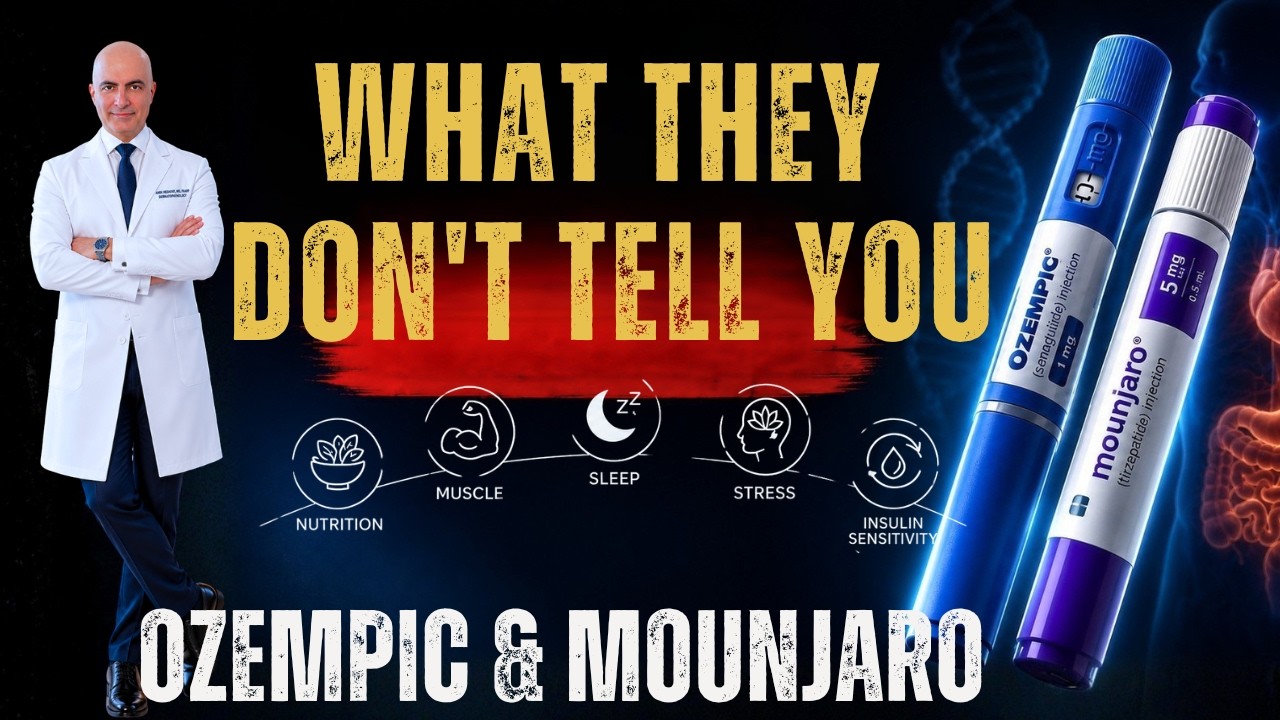
In 2005, the FDA approved a new drug for type 2 diabetes. The makers expected it to lower blood sugar. It did. But then people on the drug started losing weight. Thirty pounds. Fifty. Some even eighty.
And then it got strange. Their blood pressure dropped. Their hearts got stronger. People with failing kidneys saw the damage slow down. People who couldn't sleep through the night because of sleep apnea suddenly could. Women who hadn't had a regular period in years started having them again.
One class of drugs. Doing a list of things that, on the surface, have absolutely nothing to do with each other. How does a single medication fix your heart, your kidneys, your sleep and your hormones all at once? Those are different organs. Different problems.
For almost 20 years, that question didn't have a clean answer. It does now. And the answer, says Dr. Amin Hedayat, is the reason almost everything you've been told about these drugs, the headlines, the before-and-after photos, the fighting online about whether they're good or bad, is arguing about the wrong thing entirely.
1. The weight loss wasn't causing the other benefits
The first clue came from the big heart trials. In one major study published in the New England Journal of Medicine in 2023, hearts started getting protected within weeks. Long before people had lost any meaningful weight.
Think about what that means. If the drug only helped your heart by helping you lose weight, the heart benefit couldn't possibly arrive before the weight did. But it did.
So the weight loss wasn't causing the other benefits. The weight loss and the other benefits were both being caused by something else. Something upstream.
GLP-1 was never really a blood sugar messenger. Blood sugar was just one of the things it talks to. GLP-1 is closer to a master signal. One message your gut sends out after you eat, and that single message goes to organs all over your body at the same time, telling each one to calm down and run cleanly.
GLP-1 is closer to a master signal.Dr. Amin Hedayat, MD
Why this matters if you haven’t started yet: If you are starting a GLP-1, understanding this shift matters. You are not just chasing a number on the scale. You are turning up a signal that affects your whole metabolism at once.
2. The signal goes to more than your appetite
It tells your pancreas to release insulin, but only as much as you really need. It tells your liver to stop dumping extra sugar into the blood. It tells your stomach to slow down and empty gradually. It tells your brain, a small control center near the base called the hypothalamus, that you're satisfied and can stop eating.
It tells the cells that drive inflammation to settle down. Inflammation is your body's emergency response, the same thing behind swelling and redness, except when it runs all the time in the background it quietly damages everything.
And it tells the lining of your blood vessels to stay smooth and flexible.
Read that list back. Only one of those messages is about appetite. One. The rest are about sugar, inflammation and the health of your blood vessels. Which happen to be the exact things behind heart disease, kidney disease and most of what wears the body down as we age.
3. Your body already makes this signal, but modern life turned it down
If your body already makes this signal, why would anyone need a drug for it? Because for a lot of us, the signal has gone quiet.
Picture a smoke alarm. When it works, it goes off the moment there's a problem, then quiets down once the air clears. Now imagine you've burned toast every morning for ten years. Eventually you start ignoring the alarm. It's still beeping but you've just stopped hearing it.
That's roughly what happens with GLP-1 in modern life. Dr. Hedayat points to three common things that turn the volume down.
The first is ultra-processed food. That's food built in a factory to be easy to overeat. Chips, soda, packaged snacks, most of the middle aisles of the grocery store. When you eat whole, real food, your gut releases a strong burst of GLP-1. When you eat processed food, that burst is weak. Eat that way for years, and the signal you depend on after every meal barely shows up.
The second is chronic inflammation. When you sleep badly, live under constant stress and carry extra fat deep in your belly, that emergency response never fully switches off. And that low, constant inflammation makes your body listen to GLP-1 even less.
The third is insulin resistance. Insulin is the hormone that knocks on your cells and says, open up, let this sugar in. When your cells hear that knock all day every day, they stop answering. That's insulin resistance. The cells have stopped opening the door. And when this system gets noisy and broken, the GLP-1 signal gets drowned out with it.
Put those three together and you get most of the adult population walking around with a master signal that's barely a whisper.
4. The drug is a bridge, not the destination
When someone takes a GLP-1 drug, they're not adding a strange chemical to the body. They're turning the volume back up on a signal the body was built to make, but stopped making loudly enough.
The drug turns the signal up from the outside. But the things that turned your signal down in the first place, the food you eat, the sleep, the stress, the inflammation, are still there. The drug doesn't fix those. It covers them.
Dr. Hedayat puts it bluntly: the drug is a bridge. It is not the destination. It's like using crutches while you're healing from a broken leg.
The destination is the work that turns your own signal back up. The food. The environment. The movement. The sleep. The lowered hidden inflammation. The drug just gets you across when the current is too strong to swim on your own.
People who build that destination while they're on the bridge keep their results, often for life, sometimes even after they come off the medication. People who treat the bridge as the destination walk halfway out, stop and get swept back. Worse than before.
The drug is a bridge. It is not the destination.Dr. Amin Hedayat, MD
Why this matters if you haven’t started yet: This is the single most important fact if you are starting. The medication buys you time to do the deeper work. It does not replace it.
5. Two myths are keeping people from understanding any of this
Myth one is that these are the miracle. This is the hype crowd. The before-and-after photos. The influencers selling cheap copies of these drugs out of nowhere. The clinics handing them out like vitamins. Their myth is that the drug is the whole answer. Take the shot, watch the fat melt, done.
Here's why that's a myth. If the drug only turns the signal up from the outside, and you change nothing underneath, then the moment you stop the drug, the signal drops back. The hunger comes roaring back and the weight usually comes back too, often past where you started. That's not the drug failing. That's a bridge built to nowhere.
Myth two is the poison crowd. The drugs will destroy your muscles. They'll give you cancer. They're a scam. And the least favorite, that losing weight with help is somehow cheating.
Muscle loss. It's true that when you lose weight fast, in any way, including plain diet and exercise, some of what you lose is muscle. The real question is whether these drugs make that worse, and whether you can prevent it. The answer is that with enough protein and some strength training, muscle loss on these drugs looks about the same as muscle loss from any other method.
Cancer. This fear comes from one specific rare thyroid cancer seen in animal studies. If you or your close family have had medullary thyroid cancer, a specific rare type, these drugs aren't for you. That's a real line. But the broad idea that these drugs cause cancer in general has not held up in the large human trials, at least to date.
Side effects are real and serious, but mostly manageable under close supervision of an experienced physician who is knowledgeable about metabolic health.
And the moral one. The idea that you have to suffer to deserve to be healthy. Dr. Hedayat is blunt: we don't tell someone with high blood pressure they're cheating for taking a pill instead of just white-knuckling it. Suffering is not the price of admission to a healthy body.
Suffering is not the price of admission to a healthy body.Dr. Amin Hedayat, MD
6. Five foundations make it actually last
If you and your doctor ever decide a GLP-1 makes sense for you, here is the work that makes it actually last. Dr. Hedayat thinks of it as five foundations. This is general education, not personal medical advice. What's right for you is a conversation between you and your own physician or dietitian.
Foundation one. Protein. When the drug quiets your appetite, you eat less. So every bite has to count more. The biggest mistake people make is eating their same old diet, just smaller, and losing muscle instead of fat. The general guidance experts point to for protecting muscle during weight loss is meaningfully more protein than the standard recommendation. The exact number depends on your body, your kidneys and your goals, so set it with your doctor or dietitian. Real food does it best. Eggs. Meat, fish, chicken, Greek yogurt, beans, tofu.
Foundation two. Strength training. Think of it as muscle insurance. Every pound you lose, your body tries to take some from muscle. Lifting tells your body, no, keep the muscle, burn the fat instead. You don't need a gym or a trainer. You need a couple of sessions a week and the basic movements. Push, pull, squat, hinge, carry. The type of strength training should be determined and cleared by your clinician based on your restrictions and medical history.
Foundation three. Handling side effects the smart way. If a drug is part of your plan, the side effects usually track with how fast the dose climbs. How a medication is started and adjusted is your prescribing doctor's call, not something to change on your own. The everyday comfort tricks are simple. Drink enough water. Eat fiber from real food, like vegetables, berries, oats and beans. Smaller, slower meals. Stop when you're no longer hungry, not when you're stuffed. Double check fiber with your physician, because some underlying conditions may not handle increased fiber well.
Foundation four. Track the right things. Most people stare at the scale. Dr. Hedayat thinks it's the least useful number you've got. The scale jumps around with water, sleep and what's in your gut. Watch better signals instead. Your waist. Your strength. Your energy. Your sleep. For women, whether your cycle becomes regular. And the lab markers your doctor follows over time.
Foundation five, and this is the one that ties it all together. The habits are what you keep. Whether you stay on a medication, and how you'd ever come off it, are decisions that belong with your prescribing doctor. But the research is clear on one thing. The people who keep the protein, the training, the sleep and the food quality tend to hold onto their results. The people who lean on only the drug and change nothing underneath lose them when the drug stops.
7. The evidence shows one signal, turned back up, reaching the whole body at once
For 50 years, we've treated obesity, type 2 diabetes, fatty liver, the hormone condition in women now called PCOS, sleep apnea and a dozen other problems as separate diseases. Different specialists. Different drugs. Different waiting rooms.
But look at what they share underneath. Inflammation. Insulin resistance. A metabolism that's lost its rhythm. They're not really separate diseases. They're the same fire, breaking out in different rooms of the same house.
For decades, all we had were buckets of water for each room. A blood pressure pill here. A cholesterol pill there. A breathing machine for the sleep apnea. A different drug for the hormones. Each one chasing a symptom in one room while the fire kept spreading through the walls.
Then these drugs showed up. And almost by accident, we found something that doesn't chase one room. It turns down the heat in the whole house at once.
A large heart study called SELECT, published in the New England Journal of Medicine in 2023, followed more than 17,000 people with heart disease who were overweight but didn't have diabetes. The drug cut major heart events, heart attacks, strokes and heart-related deaths, by about 20 percent. And the protection started showing up within weeks, long before the weight came off. The weight wasn't doing the work. The signal was.
A kidney study called FLOW, published in 2024, followed over 3,500 people with diabetes and kidney disease. The drug cut the risk of kidney failure and death by 24 percent.
A sleep study published in 2024 tested one of these drugs in people with serious sleep apnea. At the higher dose, up to half of them improved so much they no longer met the line for the disease.
And in women with PCOS, studies show better insulin function, more regular cycles and higher natural pregnancy rates. Dr. Hedayat is honest about the strength of the evidence here. The weight and insulin findings are solid. The cycle and hormone findings are real but rest on smaller studies, so he holds them a little more loosely.
Look at that list again. Heart. Kidneys. Sleep. Hormones. The exact mystery from the opening. And now you know the answer. One signal, turned back up, reaching the whole body at once.
These drugs are not weight loss drugs. They turn up a master signal your body was always supposed to send, and modern life turned down. Weight loss was just the part you could see in the mirror. The real work was happening everywhere else.
And they can be a powerful bridge. But a bridge only matters if you walk all the way across it. The far side is the food, the movement, the sleep, the lowered inflammation. That's what your body keeps after the bridge is gone. That's the part the commercials don't cover.
If you're thinking about one of these medications, don't fall for the miracle crowd, and don't fall for the poison crowd. Sit down with a knowledgeable doctor. Look at your numbers. And build the far side of the bridge.
Questions people ask
Are GLP-1 drugs like Ozempic and Mounjaro only for weight loss?
No. GLP-1 drugs turn up a master signal your body makes after you eat. That signal affects blood sugar, inflammation, blood vessels, appetite, and more. Weight loss is just the one effect you can see. The drug also protects the heart, kidneys, and other organs, often before weight loss even begins.
Will I gain the weight back after stopping a GLP-1 medication?
If you only rely on the drug and change nothing underneath, the weight usually comes back when you stop, often past where you started. The people who keep their results are the ones who build new habits around protein, strength training, sleep, and real food while they're on the medication.
Do GLP-1 drugs cause muscle loss?
When you lose weight fast, in any way, some of what you lose is muscle. GLP-1 drugs are no worse than other methods. With enough protein and some strength training, muscle loss can be minimized. The fix is simple: lift something heavy and eat your protein.
Dr. Amin Hedayat is a triple board-certified physician and medical school assistant clinical professor. 5,599,259 views on the original video.
Watch the original on YouTube →