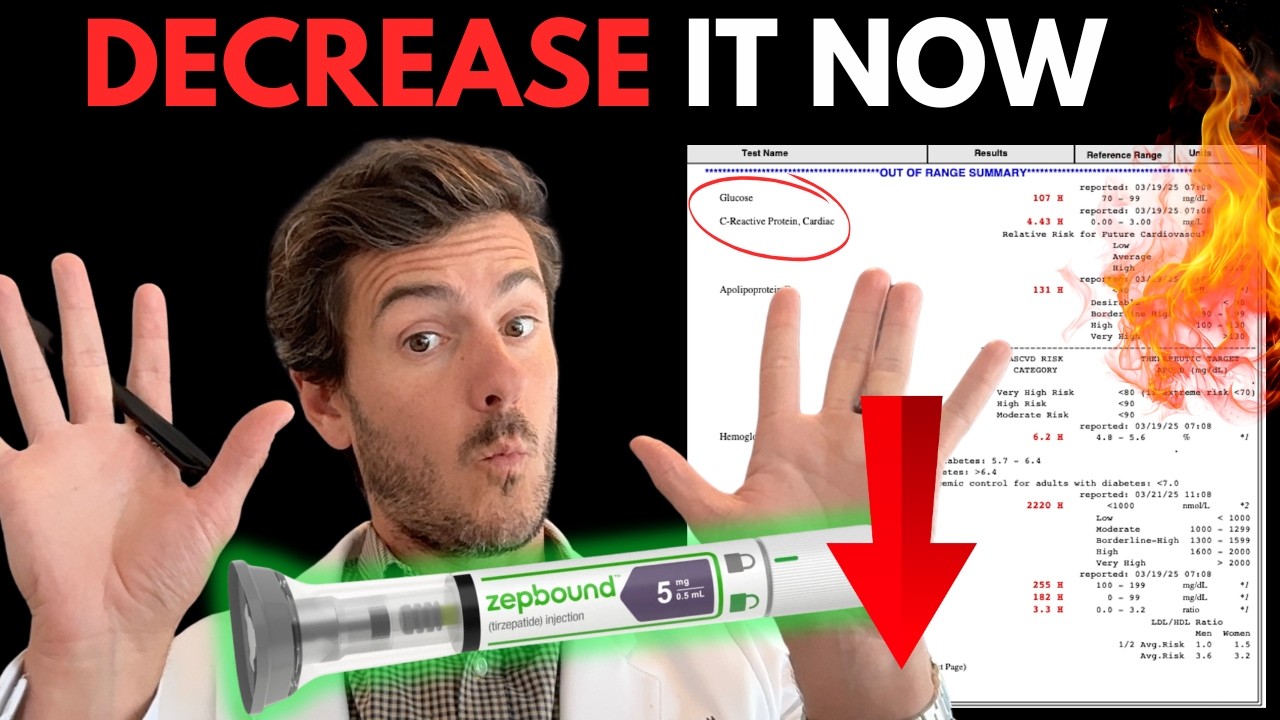
Almost every week now, a woman walks into Dr. Stirrett's clinic asking to increase her GLP-1 dose. The weight was coming off, maybe it still is, but she's exhausted in a way sleep doesn't fix. She's cold all the time. Hair is piling up in the shower drain. She has to remind herself to eat.
Her doctor either bumped her up to the next dose or told her it's expected on the medication. Maybe menopause. Maybe her age.
"Those symptoms are not the medication working," Stirrett says. "They're signs that the dosage you're taking may be too high." And every one of them, he says, shows up in blood work if you know where to look.
1. You're tired and you justify it with everything else going on
You're 54. You're busy. Stressed. Kids, parents, job. You tell yourself you're probably just doing too much.
Here's what's actually happening. Your body doesn't know you're trying to lose weight on purpose. It only knows how much food is coming in. When food slows down or drops significantly, your body tries to protect you by slowing your metabolism. The main way it does that is through your thyroid.
Your thyroid sets how much energy you burn, how warm you are, how well your hair grows. When you're not eating enough, your body stops converting thyroid hormone to the active form that actually does the work. That's why this cluster travels together: thinning hair, fatigue, cold hands and feet, constipation, brain fog.
What to check: Free T3, the active thyroid hormone. This is what drops. Most doctors never order it. They run a TSH, tell you your thyroid is fine, and stop. TSH drifts up slowly, still under 4, nothing flagged. Also check ferritin, your iron storage. Stirrett wants to see it above 50, ideally closer to 90 or 100. He sees women at 11 to 20 frequently, men too, who've been told they're not anemic because their doctor checked iron levels but never checked ferritin.
Increasing the dose means you eat even less and make all of this worse. This isn't a medication fix. The fix is more food. To eat more food, you may need to decrease your dose. Specifically, more protein and enough total calories so your body stops running in crisis mode.
Stirrett's floor: 1,000 to 1,200 calories. If you're experiencing these symptoms, your weight loss is stuck, and you're under 1,000 calories a day, you likely have your answer. The dose needs to come down.
I honestly didn't want to hear the truth.Dr. Stirrett
2. You forget to eat and you're bragging about it
It's 2 p.m. You've had coffee and maybe half a yogurt. Food is uninteresting. For some reason, a lot of people believe this is the point of the medication, to turn interest in food all the way off.
Stirrett is blunt about this. Appetite suppression is a side effect of the GLP-1, not the goal. It's a side effect you tolerate at the smallest effective dose that gets the job done. "We're trying to repair your metabolism, not your interest in dinner."
He gets it. You spent your life overeating, thinking about food constantly, and suddenly something turns that off. It's exciting. The point is to achieve that to the smallest degree possible that still gives you the weight loss you need.
Here's the test: Can you eat 80 to 100 grams of protein in a day without feeling like it's the most difficult, dreadful thing in the world? If yes, you're probably okay. If it feels impossible, if you look at a chicken breast and feel nothing but obligation, if you're hitting 40 grams and can't do one more, you need to look at dosage.
The problem is that if weight is coming off, people are so encouraged that no one wants to look deeper.
Appetite suppression is a side effect of the GLP-1. It's not the goal.Dr. Stirrett
3. You're down 30 lb but you feel weaker
You're seeing it in the mirror. Your arms are shrinking a little too much. You feel gaunt. You get more fatigued walking upstairs or back and forth from your car at the grocery store.
The mechanism is simple. Your body needs a certain amount of protein each day to maintain muscle mass. If you don't get it from your plate, it takes it from you. Your legs, your glutes, your arms. And yes, your heart muscle, because the heart is muscle too. A GLP-1 dose that's too high makes this trade happen faster.
What makes it easy to miss is the reward on the scale. You hop on, you're down, you haven't been able to lose weight in years. Everybody at church tells you how good you look. But muscle is heavy. Losing it can look like progress. Your body is quietly getting more fragile.
Evaluate this for yourself. First, how fast are you losing? On average over the last month, how many pounds per week? Stirrett likes to see about 1.5 pounds per week for sustainable weight loss. If you're losing 2.5, 3, 3.5 pounds per week, you're probably losing a lot of muscle.
Second, track your protein for three days. Take the average. Use MyFitnessPal or Lose It. Third, can you do the things physically you could do three months ago? Carry grocery bags, get up off the floor, climb a flight of stairs without your heart pounding?
If weight is coming off quickly, protein is low, and you're feeling weaker, you're not at the right dose. Stirrett doesn't care what the scale says.
The fix has three parts. Protein up. He likes beef protein isolate, which unlike whey can be a great way to get an extra 25 to 30 grams when needed. Resistance training two to three times a week, that's all, to signal your body that the muscle you have is valuable. And slow the weight loss down, which may mean decreasing the dose so you can get your calories up.
Why this matters if you haven’t started yet: Losing muscle makes you metabolically less healthy at the end, even if the scale looks good.
4. You're losing more than 2.5 lb a week, month after month
The thing you're proudest of may be your biggest warning sign. If you're losing more than 2.5 pounds per week, week after week, this is not a better result. People online saying they lost 45 or 50 pounds in three months? Too fast. The faster it leaves, the faster it comes back. And a big chunk of what's leaving at that rate is muscle, not fat.
Stirrett gives a real pattern. A woman came in nine months into her GLP-1, down 71 pounds. Nobody in her life had anything but praise. Her labs looked good on paper. Hemoglobin A1C was 5.2, perfect. Fasting insulin was 4, perfect. Her clinic told her everything's good, keep going, kept her on the highest dose she'd climbed to.
Here's what nobody looked at. Her free T3 was at the very bottom of the range. Her ferritin was 14. She was averaging maybe 900 calories per day, 45 grams of protein tops. She came in because she felt weaker, like a shadow of her old self, worried she'd done significant damage. "I'm tired, and I feel like the weight loss maybe wasn't worth it."
The key takeaway: the dose needs to come down to allow her to eat more than 900 calories, eat more protein, and start strength training to build back the muscle she lost. It may be very difficult to do this staying on 7.5 milligrams of Zepbound. Her insulin is perfect, meaning she doesn't need that much to achieve blood sugar control. 7.5 milligrams is very hot and heavy for a person in this position.
A normal lab result does not give you permission to continue at the same dose. Those numbers were normal because she was barely eating, not because her metabolism got fixed.
This is why Stirrett cares so much about pace. Slower is not less impressive. Slower weight loss means more sustainable weight loss. If you're dropping faster than 2.5 pounds per week, the conversation shouldn't be let's keep cruising. It should be let's take a step back and make sure we're doing this safely.
5. You have sulfur burps that smell like rotten eggs
Not glamorous. Maybe a little more heartburn than you're used to, burning behind your breastbone at night when you lay down, or the feeling like dinner is still in your chest at bedtime.
Here's what this is. The medication slows how fast food moves through your digestive system, how fast your stomach empties. That's part of how it works. Food stays in longer, you feel fuller longer, you eat less. But there's a point where slow becomes too slow.
When food sits for too long, it starts to ferment instead of digest. That's where the sulfur smell comes from. Your food is off-gassing from bacteria. The pressure from the stomach that isn't emptying pushes acid back up to your esophagus, where it doesn't belong. That's heartburn.
Your doctor might give you something to block the acid, thinking it's an acid problem. But if you block the acid, it just makes it harder to absorb B12 and iron, and it doesn't fix the problem. And any digestive issues you have currently are going to get amplified on a GLP-1. It exposes your weakness.
Before touching the dose, try these things first. Smaller meals more often. Your stomach is emptying slowly, so don't dump all your calories and protein into one sitting. This is one reason fasting doesn't always work well on a GLP-1 when you shorten your feeding window and try to cram all your calories into it. Spread protein out: 30 grams three times a day is easier than one or two enormous meals.
No coffee on an empty stomach. Stomach acid is already off because everything's emptying slowly. Don't eat right before bed. Cut food off two to three hours before so you're not laying down right after eating. Pay attention to what you're eating in relation to your symptoms. If spicy food, coffee, citrus, tomato products are causing burps or heartburn, note those foods and pull back.
But if you've done all this and you're still sleeping with your head propped up on pillows, your body might be telling you this dose is more than it can handle.
6. You're not sad exactly, just flat
Nothing sounds good. Not the food, not the plans, not the trips you were looking forward to. You don't feel like calling people back. A lot of people blame themselves, think maybe it's mild depression.
There are three reasons Stirrett sees this happen on a GLP-1. First, you're undereating. Your body runs on food. Turn down the amount too low and it impacts brain health.
Second, you may be low on the raw materials. Your brain builds its mood out of amino acids from protein. It needs B12, vitamin D, iron to do this. When he runs labs on someone feeling flat, these are the markers he looks at. Vitamin B12, he wants above 500 at least. Most people are under 300. Vitamin D, he wants over 50. Most people are under 20. Ferritin, women should be closer to 100. Most are in the 20s and 30s. And free T3, because a slow thyroid feels like depression.
These are not exotic tests. They're just tests no one's ordered on you yet.
The fix: more food, more protein, replace the nutrients that are actually low (vitamin D, iron, B12), and decrease your dose. In terms of mood, it usually takes two to three weeks to see a difference, but things typically improve quickly.
The one thing that gets misread as needing a higher dose
You take your shot. Day one, two, three, four, food noise is quiet. Then day six, day seven, food noise returns with a vengeance. You start thinking about snacks again. Snacking around 7 p.m. with Netflix. Carb cravings go back up. Wine cravings go back up. And the conclusion is always the same: my dose is not enough for me. Time to increase.
On a seven-day injection cycle, this is rarely the case. What's happening is your medication is leaving your body fairly quickly toward the end of the week. You don't have enough in your bloodstream to give you that same level of stimulation. You're in a trough.
This is a timing problem, not a medication problem. The answer for many people is adjusting the frequency of the dose. Instead of going from one dose to the next, which is nearly a 50 or 100 percent jump, Stirrett moves patients from injecting every seven days to every five days. Same amount in the shot. This just keeps blood levels steady, less up and down movement. For many people, this keeps the food noise away just fine without increasing the dose at all.
Why this matters if you haven’t started yet: If food noise returns on day six or seven, try injecting every five days at the same dose before increasing.
Notice what is not on the list: going higher. Not one of these six signs means you need more medication. Every one of them is your body telling you it needs more food, more protein, more nutrients, or more time between doses.
The scale can lie. It can show you progress while you quietly get weaker, colder, flatter. The blood work doesn't lie, if you know where to look. And you don't need a doctor to notice you're tired, you can't eat, or you feel like a shadow. You already have the information. You've just been told it doesn't mean anything.
Questions people ask
How do I know if my GLP-1 dose is too high?
Six signs: you're exhausted in a way sleep doesn't fix, you forget to eat and can't get 80 to 100 grams of protein, you're losing weight but feeling weaker, you're losing more than 2.5 pounds per week consistently, you have sulfur burps or constant heartburn, or you feel emotionally flat. Check free T3, ferritin, B12, and vitamin D.
What should I do if food noise comes back on day 6 or 7 of my GLP-1 shot?
This is usually a timing problem, not a dose problem. Instead of increasing the dose, try injecting every five days instead of every seven, using the same amount in the shot. This keeps blood levels steady and often eliminates the food noise without increasing your dose at all.
How fast should I be losing weight on Ozempic or Mounjaro?
Dr. Stirrett likes to see about 1.5 pounds per week for sustainable weight loss. If you're losing 2.5 to 3 pounds or more per week consistently, you're likely losing too much muscle and your dose may be too high, even if the scale looks impressive.
Dr. Stirrett runs a weight loss and hormone clinic where he works directly with patients on GLP-1 medications, running comprehensive blood work and building protocols based on individual lab data. 136,872 views on the original video.
Watch the original on YouTube →